Introduction
For local businesses, generating a steady stream of qualified leads is one of the biggest challenges in today’s competitive digital marketplace. Whether you own a restaurant, law firm, dental clinic, real estate agency, digital marketing company, or retail store, your potential customers are searching online before making a purchase decision. The question many business owners ask is: Should I invest in Google Business Profile optimization or focus on building a professional website?
The truth is that both play important roles, but they serve different purposes in the customer journey. A well-optimized Google Business Profile (GBP) helps your business appear in Google Search and Google Maps when people search for services nearby. A website, on the other hand, provides complete information about your business, builds credibility, and converts visitors into customers through detailed service pages, contact forms, and valuable content.
Many businesses mistakenly believe they only need one of these assets. Some rely entirely on their Google Business Profile and ignore their website, while others invest heavily in website design but never optimize their Google Business Profile. This imbalance often results in missed opportunities and lower local lead generation.
Modern local business SEO is no longer about choosing one over the other. Google’s ranking algorithms evaluate multiple signals, including website quality, business profile optimization, customer reviews, local citations, and overall online authority. Businesses that integrate both assets into a unified local SEO strategy typically achieve better visibility, attract more qualified traffic, and generate higher-quality leads.
In this guide, you’ll learn the key differences between Google Business Profile vs website, when each one delivers the greatest value, how they work together to improve Google Maps ranking, and the best practices that help local businesses attract more customers without relying solely on paid advertising.
Google Business Profile vs Website

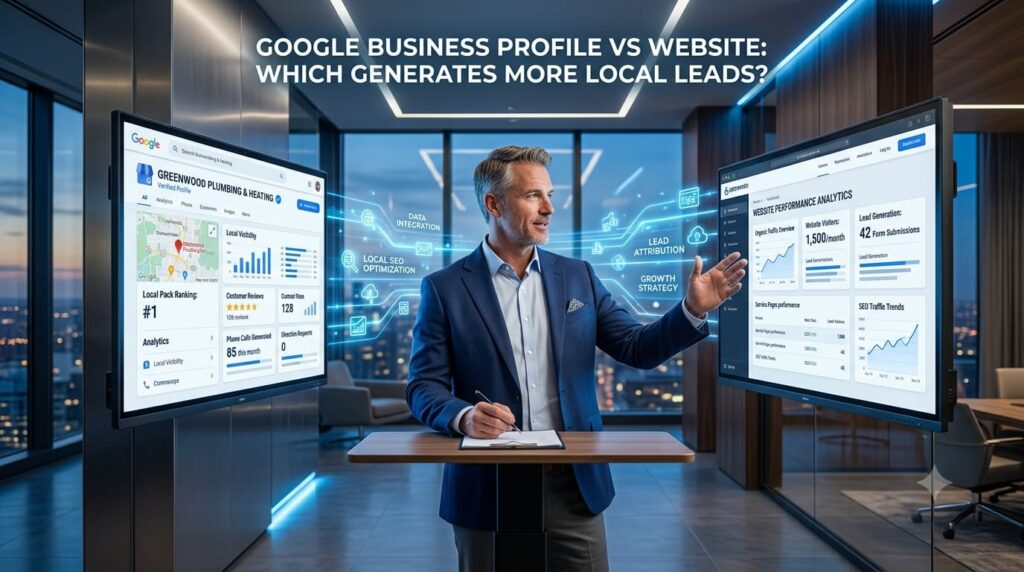
Google Business Profile and a website serve different purposes, but neither replaces the other. A Google Business Profile increases local visibility and helps customers discover your business quickly, while a website builds trust, provides detailed information, and converts visitors into paying customers. Businesses that use both together typically generate stronger long-term results.
When comparing Google Business Profile vs website, it’s important to understand how customers search for local businesses. Imagine someone searches for “digital marketing agency near me” or “best dentist in Ahmedabad.” Before they even visit a website, Google often displays a map with local business listings. This is known as the Local Pack, and businesses appearing here receive significant visibility.
Your Google Business Profile is responsible for helping you appear in these local search results. It displays essential information such as:
- Business name
- Address
- Phone number
- Business hours
- Customer reviews
- Directions
- Photos
- Frequently Asked Questions
- Recent updates and posts
For customers looking for quick information, this may be enough to encourage a phone call or request directions.
A website, however, offers much more depth. It allows you to showcase your expertise, explain your services, publish educational content, display testimonials, answer customer questions, and guide visitors through the buying process. Unlike a Google Business Profile, your website is completely under your control. You decide the layout, branding, content, user experience, and conversion strategy.
For example, a Google Business Profile can tell potential customers that your business offers SEO services. Your website can explain your SEO process, share success stories, highlight case studies, answer common questions, and provide a consultation form—all of which help convert interested visitors into qualified leads.
Another important difference is search visibility. Google Business Profile primarily targets local searches and Google Maps, while a website can rank for hundreds or even thousands of keywords through effective local business SEO and content marketing.
The comparison below highlights the strengths of each platform.
Google Business Profile | Website |
Appears in Google Maps and Local Pack | Ranks in organic search results |
Free to create and maintain | Requires development and maintenance |
Best for local discovery | Best for detailed information and conversions |
Displays reviews and ratings | Builds authority through valuable content |
Encourages phone calls and directions | Generates enquiries through forms and landing pages |
Supports Google Maps ranking | Supports broader SEO strategy |
Businesses that focus only on their website often miss opportunities to appear in Google Maps. Likewise, businesses that rely solely on Google Business Profile have limited space to educate customers and differentiate themselves from competitors.
A properly optimized Google Business Profile SEO strategy should complement a professionally designed website. Together, they strengthen your online presence, improve local search visibility, and create multiple pathways for potential customers to discover your business.
For example, someone may first find your business through Google Maps, visit your website to learn more about your services, read customer testimonials, and finally submit an enquiry form. This journey demonstrates why both platforms are essential components of successful local lead generation.
Businesses that consistently invest in Google Business Profile optimization while maintaining an SEO-friendly website are generally more competitive in local search results because they send stronger trust signals to Google and provide a better experience for potential customers.
Internal linking opportunity: Learn more about Local SEO Services and Website Development for Business Growth.
When You Need Both
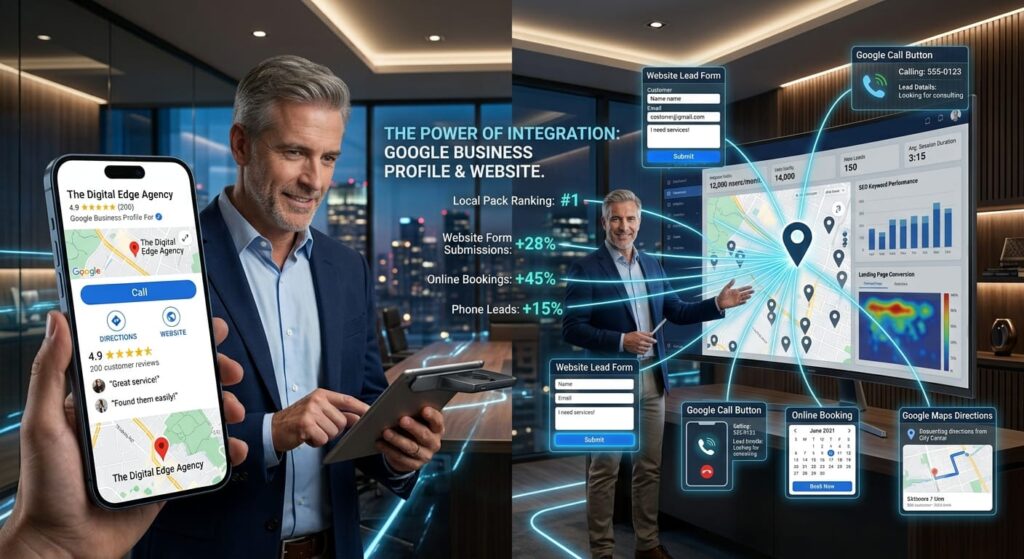
The most effective local marketing strategy is not choosing between a Google Business Profile and a website—it is using both together. A Google Business Profile helps customers discover your business, while a website builds trust, answers questions, and converts visitors into qualified leads. Businesses that combine both typically achieve better local rankings and higher conversion rates.
Many small businesses start with only a Google Business Profile because it is free, easy to set up, and can generate phone calls quickly. This works well during the early stages, especially for businesses that rely on local customers. However, as competition increases, relying only on your Google Business Profile limits your ability to stand out.
For example, imagine two plumbing companies appear in Google Maps with similar ratings. A customer clicks on both listings. The first business has only a Google Business Profile with a few photos and basic contact information. The second business has an optimized profile that links to a professional website containing service pages, customer testimonials, pricing information, emergency services, FAQs, and online booking. In most cases, the second business builds greater confidence and is more likely to receive the enquiry.
A website also allows businesses to target keywords that a Google Business Profile cannot. Through blogs, location pages, and service pages, you can rank for searches such as:
- Best digital marketing agency for small businesses
- Affordable SEO services in Ahmedabad
- Wedding photographer near SG Highway
- Residential property consultant in Ahmedabad
- Family dentist in Satellite Ahmedabad
These pages expand your online visibility beyond Google Maps and attract customers at different stages of their buying journey.
Another advantage is ownership. While your website is a digital asset that you fully control, Google’s Business Profile platform and algorithms can change over time. Having a strong website ensures your business remains visible even if local search features evolve.
Businesses should also use both platforms to reinforce trust. Information such as your business name, address, phone number, operating hours, and services should remain consistent across your website and Google Business Profile. This consistency strengthens local business SEO and improves Google’s confidence in your business information.
An integrated approach also improves customer experience. A typical customer journey might look like this:
- Searches for a local service on Google.
- Finds your business in Google Maps.
- Reads customer reviews.
- Visits your website for detailed information.
- Views your portfolio or case studies.
- Submits an enquiry or calls your business.
Without either your website or your Google Business Profile, this journey becomes incomplete.
The following comparison illustrates how both platforms support different stages of the customer journey.
Customer Journey Stage | Google Business Profile | Website |
Local discovery | ✅ Excellent | ✅ Supports SEO |
Reviews & ratings | ✅ Yes | ✅ Can display testimonials |
Service information | Limited | Comprehensive |
Content marketing | No | Yes |
Online booking/forms | Limited | Fully customizable |
Brand authority | Moderate | High |
Lead conversion | Good | Excellent |
Rather than asking “website vs Google Business Profile,” business owners should focus on how both platforms complement each other. Together, they create a stronger online presence, improve customer trust, and increase the chances of converting local searches into paying customers.
Internal linking opportunity: Learn more about Website Development and Local SEO Services.
Local SEO Factors

Local SEO is influenced by multiple ranking signals, including Google Business Profile optimization, website quality, customer reviews, local relevance, backlinks, and overall online trust. Businesses that consistently optimize these factors are more likely to improve their Google Maps ranking and generate qualified local leads.
Many business owners believe that simply creating a Google Business Profile guarantees visibility in Google Maps. In reality, Google uses hundreds of signals to determine which businesses appear in local search results.
One of the most important factors is Google Business Profile optimization. A complete profile sends strong trust signals to Google. Businesses should ensure that every section is fully completed, including:
- Accurate business name
- Correct address and phone number
- Business categories
- Operating hours
- Service descriptions
- High-quality photos
- Products and services
- Frequently Asked Questions
- Weekly Google Posts
Another major ranking factor is customer reviews. Google values businesses with authentic, recent, and positive reviews because they indicate customer satisfaction. Encouraging happy customers to leave honest feedback not only improves credibility but can also positively influence Google Maps ranking.
Your website also plays a significant role in Google Business Profile SEO. Google compares information across your website and Business Profile to verify consistency. If your website contains outdated contact information or inconsistent service details, it can weaken your local SEO performance.
Content quality is another important ranking signal. Publishing useful blogs, local guides, FAQs, and service pages helps Google understand your expertise while providing value to potential customers. For example, a dental clinic could publish articles about oral hygiene tips, while a real estate agency could create neighbourhood guides and property-buying resources.
Backlinks from reputable local websites, business directories, chambers of commerce, and industry organizations also strengthen local authority. These links act as endorsements that increase Google’s confidence in your business.
Technical SEO should not be overlooked either. Google prefers websites that:
- Load quickly
- Are mobile-friendly
- Use HTTPS security
- Have clear navigation
- Include structured data (Schema Markup)
- Offer a positive user experience
Consistency across online directories is equally important. Your business name, address, and phone number (NAP) should match exactly across your website, Google Business Profile, and local business listings. Even small inconsistencies can create confusion for search engines.
The table below summarizes the most important local SEO ranking factors.
Local SEO Factor | Why It Matters |
Google Business Profile Optimization | Improves visibility in local search and Maps |
Customer Reviews | Builds trust and supports local rankings |
Website SEO | Strengthens authority and organic visibility |
NAP Consistency | Confirms business information across the web |
Local Content | Targets location-based search queries |
Backlinks | Increases website authority |
Mobile-Friendly Website | Improves user experience and rankings |
Regular Google Posts | Keeps your profile active and engaging |
Businesses that consistently improve these areas are far more likely to increase Google Maps leads than those relying on one-time optimization. Local SEO is an ongoing process that requires regular updates, monitoring, and continuous improvement.
Instead of treating Google Business Profile optimization as a one-time task, successful businesses make it part of their long-term local lead generation strategy. Small improvements made consistently often produce stronger and more sustainable results than occasional large changes.
Internal linking opportunity: Learn more about Technical SEO, Local SEO, and Google Business Profile Optimization.
Lead Generation

Generating local leads is not just about appearing in Google Search—it is about turning online visibility into real phone calls, enquiries, bookings, and sales. Businesses that combine an optimized Google Business Profile with a high-converting website create multiple opportunities for customers to contact them, resulting in stronger and more consistent local lead generation.
Many businesses assume that ranking on Google automatically leads to more customers. While visibility is essential, it is only the first step. The real objective is encouraging potential customers to take action after discovering your business.
Google Business Profile is highly effective for capturing customers who are ready to make an immediate decision. For example, someone searching for “coffee shop near me” or “electrician near me” is often looking for a business they can contact right away. If your profile displays positive reviews, attractive photos, updated business hours, and a click-to-call button, that customer may contact you without even visiting your website.
However, not every customer makes an instant decision. For higher-value services such as legal consulting, healthcare, real estate, financial planning, or digital marketing, buyers usually compare several businesses before choosing one. This is where your website becomes essential.
A professional website allows you to answer important questions before customers contact you. You can showcase:
- Detailed service pages
- Customer success stories
- Before-and-after case studies
- Testimonials and Google reviews
- Frequently Asked Questions
- Pricing information (where appropriate)
- Contact forms
- Appointment booking
- Educational blog articles
These trust-building elements reduce hesitation and increase conversion rates.
Another effective strategy is creating location-specific landing pages. Instead of having one generic service page, businesses can create optimized pages targeting different cities or neighborhoods. For example:
- SEO Services in Ahmedabad
- Website Development in Gandhinagar
- Digital Marketing Agency in Surat
- Real Estate Consultant in SG Highway
These pages help attract highly targeted visitors while improving local business SEO.
Businesses should also make it easy for customers to take the next step. Every important page should include a clear call-to-action such as:
- Call Now
- Request a Free Consultation
- Get a Free Quote
- Book an Appointment
- Contact Our Team
Simple improvements like reducing form fields, adding WhatsApp contact buttons, and displaying trust badges can significantly increase enquiry rates.
The following table illustrates how Google Business Profile and a website contribute to local lead generation.
Lead Generation Activity | Google Business Profile | Website |
Phone Calls | ✅ Excellent | ✅ Good |
Direction Requests | ✅ Excellent | Limited |
Contact Form Enquiries | Limited | ✅ Excellent |
Appointment Booking | Good | ✅ Excellent |
Educational Content | No | ✅ Excellent |
Service Comparison | Limited | ✅ Excellent |
Trust Building | Good | ✅ Excellent |
Long-Term SEO Traffic | Limited | ✅ Excellent |
Businesses that focus on both discovery and conversion consistently generate more qualified enquiries than those relying on only one marketing channel. Instead of viewing your Google Business Profile and website as separate assets, treat them as two essential parts of the same local lead generation strategy.
Internal linking opportunity: Learn more about Conversion Rate Optimization and Local SEO Services.
Best Practices

The best-performing local businesses continuously optimize both their Google Business Profile and website instead of treating them as one-time projects. Consistent updates, accurate information, and customer-focused improvements help maintain strong local rankings and generate more qualified leads over time.
Whether you’re a small local business or a multi-location company, following proven best practices helps maximize the effectiveness of both platforms.
Google Business Profile Best Practices
- Complete every section of your profile.
- Select the most relevant primary and secondary business categories.
- Upload high-quality business, team, office, and product photos regularly.
- Publish Google Posts every week.
- Respond to every customer review professionally.
- Keep business hours updated, including holidays.
- Add products and services with optimized descriptions.
- Answer frequently asked customer questions.
- Encourage satisfied customers to leave honest reviews.
Website Best Practices
Your website should support both users and search engines. Focus on:
- Fast loading speed
- Mobile-friendly design
- Clear navigation
- SEO-optimized service pages
- Location-specific landing pages
- Helpful blog content
- Strong internal linking
- Visible contact information
- Easy enquiry forms
- SSL security (HTTPS)
Publishing fresh, valuable content also helps improve organic rankings and establishes your business as an authority in your industry.
Businesses should regularly monitor website traffic, phone calls, direction requests, and enquiry forms to understand which channels generate the highest-quality leads. Combining insights from Google Analytics, Google Search Console, and Google Business Profile Performance helps identify opportunities for further improvement.
The following checklist can be used during monthly SEO reviews.
Local SEO Best Practices Checklist
- ✅ Complete Google Business Profile.
- ✅ Maintain consistent business information across all online platforms.
- ✅ Collect genuine customer reviews every month.
- ✅ Publish Google Posts regularly.
- ✅ Optimize website speed and mobile performance.
- ✅ Create dedicated service pages.
- ✅ Build location-specific landing pages.
- ✅ Add structured data (Schema Markup).
- ✅ Publish informative blog articles.
- ✅ Track calls, form submissions, and website traffic.
- ✅ Review Google Maps performance regularly.
- ✅ Update outdated business information immediately.
Following this checklist helps businesses maintain strong visibility in both Google Search and Google Maps while supporting long-term local lead generation.
Internal linking opportunity: Learn more about Website SEO, Technical SEO, and Content Marketing.
Conclusion

If you’re trying to choose between a Google Business Profile and a business website, the answer isn’t one or the other—it’s both. Each serves a different purpose, and together they create a stronger digital presence that helps your business attract more qualified local customers.
A Google Business Profile is often the first thing potential customers see when searching for businesses nearby. It helps your company appear in Google Maps and local search results, making it easier for people to call, request directions, read reviews, and contact you instantly. For businesses that depend on local customers, this visibility is essential.
A professional website, on the other hand, gives you complete control over your brand, content, and customer experience. It allows you to showcase your products or services in detail, rank for a wider range of keywords through SEO, publish valuable content, collect leads through contact forms, and build long-term authority in your industry.
The businesses that consistently generate the most local leads don’t rely on only one platform. They optimize their Google Business Profile to improve local visibility while investing in a fast, SEO-friendly website that converts visitors into customers. When these two assets work together, they strengthen your online credibility, improve search visibility, increase organic traffic, and create multiple paths for potential customers to contact your business.
Rather than asking whether a Google Business Profile or a website is better, focus on creating a connected digital marketing strategy where both platforms support each other. This combination not only improves local rankings but also builds trust, generates high-intent leads, and delivers sustainable business growth for years to come.
FAQ
Yes. A Google Business Profile helps you appear in local search results, while a website provides detailed information, builds credibility, and converts visitors into customers.
Google Business Profile often generates more direct local inquiries through calls, direction requests, and map searches, while a website helps educate visitors, build trust, and convert them into paying customers. Together, they create the strongest local marketing strategy.
Yes. Businesses can appear in local map results using an optimized Google Business Profile. However, having a professional website significantly improves credibility, SEO performance, and overall lead generation.
Complete every section, add high-quality photos, maintain accurate business information, publish regular updates, collect customer reviews, and respond to reviews promptly to improve local visibility.