
How Real Estate Companies Can Generate High-Intent Leads Without Increasing Ad Spend
Real estate lead generation is one of the most critical operational challenges for real estate companies, developers, brokerages, and independent consultants today. Many businesses assume that increasing their advertising budgets will automatically generate more buyers and sellers. However, higher ad spend does not always translate into better business outcomes. Without a well-planned, multi-channel marketing strategy, businesses can end up paying more for the same or even fewer leads while attracting window-shoppers with little genuine intent to transact.
The real opportunity in modern real estate marketing is not simply generating a larger volume of leads, but attracting high-intent leads—prospective buyers and investors who are actively searching for properties, comparing specific developments, or seeking professional real estate advice. These prospects are more likely to move forward through the sales pipeline because they already have a genuine interest in making a property purchase or investment.
Modern digital marketing for real estate has therefore evolved beyond simply increasing advertising budgets. Successful real estate businesses combine Search Engine Optimization (SEO), Google Business Profile optimization, local search visibility, educational content marketing, and carefully targeted advertising to build a stronger and more sustainable lead generation system.
Whether you represent a property developer, real estate agency, brokerage, or independent consultant, the strategies discussed in this guide explain how to improve real estate lead generation by focusing on lead quality, search intent, organic visibility, and conversion efficiency—without continuously increasing your advertising spend.
Why More Ad Spend Doesn’t Always Mean More Property Leads
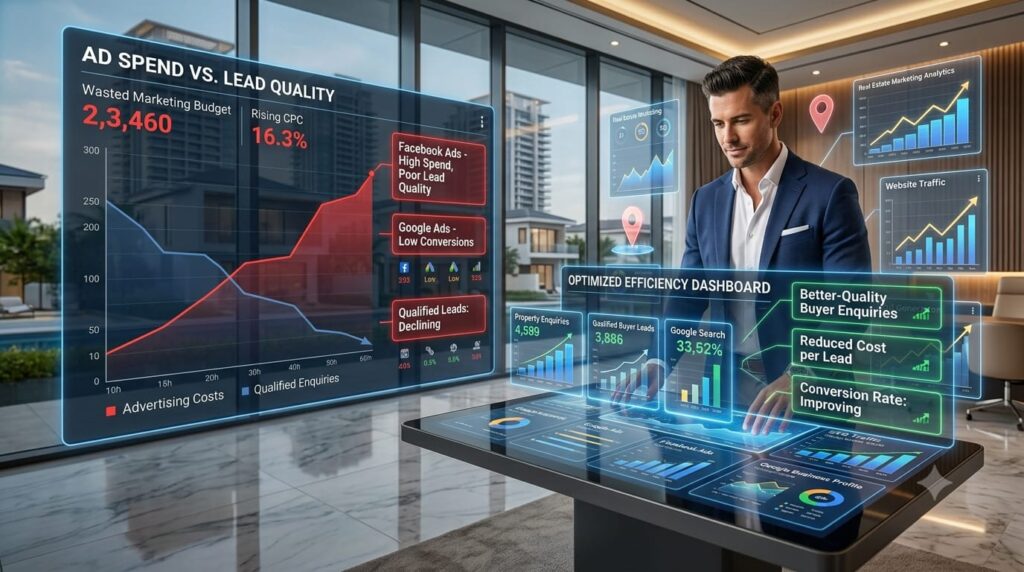
A pervasive misconception in corporate marketing is that lead generation is a linear function of ad spend: double the budget, double the leads. In competitive real estate markets, this assumption is fundamentally flawed. The ultimate objective of a mature marketing operation is not simply buying more traffic, but systematically improving lead quality, conversion velocity, and overall marketing ROI.
The Diminishing Returns of Escalating Ad Budgets
Year over year, real estate companies experience upward pressure on customer acquisition costs (CAC). Competition on dominant advertising platforms such as Google Ads, Meta (Facebook and Instagram) Ads, and regional property portals continues to intensify. As more competitors bid for the same high-value keyword terms (e.g., ‘luxury apartments for sale’ or ‘commercial real estate investment’), cost-per-click (CPC) and cost-per-lead (CPL) escalate dramatically.
Simply pouring additional financial capital into unoptimized campaigns produces severe diminishing returns. If your digital infrastructure suffers from structural friction—such as slow-loading property listing pages, poorly designed mobile interfaces, lack of interactive floor plans, or absence of trust signals (such as verified client testimonials, builder credentials, and transparent pricing)—prospective buyers will bounce immediately upon arrival. In this scenario, increasing your ad spend only serves to funnel more expensive traffic into a leaky digital bucket.
Broad Audiences vs. High-Intent Buyers
Another frequent pitfall is targeting overly broad audience segments rather than laser-focused buyers with immediate purchase intent. Consider the profound behavioral difference between two digital users:
- The Casual Browser: A casual user scrolling through social media who pauses for two seconds to look at an aesthetic photograph of a luxury living room. This user is in an entertainment or discovery mindset, far removed from making a financial commitment.
- The High-Intent Buyer: A prospective buyer actively typing ‘3 BHK ready-to-move apartments in Ahmedabad with OC received’ into a search engine. This individual has evaluated their finances, discussed requirements with family, and is actively comparing available inventory.
The latter prospect is infinitely closer to closing. Marketing strategies must be engineered to capture high-intent search queries rather than interrupting casual browsers with generic banner ads.
Optimizing Paid Campaigns for Efficiency
This is not to suggest that paid advertising is obsolete; rather, it demands rigorous operational discipline. Successful Google Ads campaigns for real estate require continuous keyword refinement, aggressive negative keyword pruning, hyper-local geographic targeting, device-specific bid adjustments, and dedicated landing page optimization. Implementing these refinements frequently slashes wasted ad spend while simultaneously boosting lead quality.
The Foundational Role of SEO in Real Estate Lead Generation

Search Engine Optimization (SEO) is arguably the most powerful long-term asset in a real estate company’s marketing portfolio. By positioning your brand prominently when buyers actively search for property solutions, SEO delivers one of the highest Return on Investment (ROI) channels available in digital marketing.
Unlike paid advertising, which ceases generating traffic the exact moment your monthly ad budget is exhausted, a robust SEO asset continues to compound in value over time. A properly structured, authoritative real estate website can rank organically for hundreds, if not thousands, of high-intent search queries every single day, working for your business 24 hours a day, 365 days a year.
Anatomy of Professional Real Estate SEO
Comprehensive real estate SEO services encompass a wide array of technical, structural, and content-driven optimizations designed to signal superior relevance and authority to search engine crawlers. Key optimization areas include:
- Property Pages: Individual property listing pages optimized with rich metadata, high-resolution compressed imagery, virtual tour embeds, pricing tables, and downloadable brochures.
- Location Pages: Dedicated landing pages targeting specific micro-markets, neighborhoods, and suburbs (e.g., SG Highway, Satellite, Bopal, or Prahlad Nagar).
- Project Pages: Comprehensive pages for upcoming, under-construction, and completed residential or commercial developments.
- Blog Content: Informational and transactional articles addressing buyer questions, legal procedures, and market analysis.
- Technical SEO: Core Web Vitals, HTTPS security, XML sitemaps, canonical tags, and mobile responsiveness.
- Website Speed & Performance: Optimizing server response times, image lazy-loading, and minimizing render-blocking scripts.
- Structured Data & Schema: Implementing Schema.org markup (RealEstateAgent, SingleFamilyResidence, LocalBusiness) to capture rich snippets in search results.
Capturing Micro-Intent Through Long-Tail Keywords
Generic keyword targeting (e.g., ‘apartments’) attracts unqualified traffic and drains marketing resources. Professional real estate SEO targets hyper-specific, long-tail search queries that reflect advanced stages of the buyer’s journey. Examples include:
- Residential Search: 2 BHK apartments in Ahmedabad under 60 lakhs
- Commercial Search: Commercial office space for sale near corporate hub
- Niche Luxury Search: Luxury villas with private garden on SG Highway
- Affordable Housing: Affordable 1 BHK flats for first-time home buyers
- Investment Search: High-yield commercial investment property in Gujarat
These specific queries indicate acute buying intent. When your website answers these exact queries thoroughly, conversion rates skyrocket.
Long-Term Authority and Compounding Returns
SEO builds institutional authority. When search engine algorithms consistently observe authoritative content, fast load times, optimal mobile usability, and positive user engagement metrics (such as low bounce rates and high dwell time), organic rankings improve naturally. Partnering with an experienced real estate digital marketing agency allows companies to integrate technical SEO with content marketing and local search visibility, creating an unstoppable, compounding lead generation asset.
Maximizing Google Business Profile for Local Dominance

For localized businesses like real estate agencies, brokerages, and local developers, the Google Business Profile (GBP) is arguably the most powerful free marketing tool available. When prospective buyers or sellers search for local services, Google prominently displays its Local Pack (map listings) above organic website results.
Capturing High-Intent Local Searches
Consider the mindset of a user typing these queries into their mobile device:
- Real estate company near me
- Best property consultant in Ahmedabad
- RERA registered real estate agents near me
- Commercial real estate broker office open now
A fully optimized Google Business Profile ensures your enterprise captures these high-intent local searches, connecting you directly with ready-to-transact local clients.
Best Practices for Google Business Profile Optimization
To maximize visibility and conversion from your GBP listing, implement these essential optimization protocols:
- Complete Business Information: Ensure your legal business name, address, phone number (NAP), and website URL are meticulously consistent across the web.
- Accurate Hours: Maintain precise operating hours, including special holiday hours.
- Visual Content: Regularly upload high-resolution photographs of your office, team, headquarters, and featured properties.
- Regular Updates: Publish weekly Google Posts highlighting new project launches, open houses, or market reports.
- Customer Review Management: Actively solicit and respond professionally to all customer reviews. Positive reviews act as powerful social proof.
- FAQ Section: Utilize the Q&A section to address common client queries regarding commission, documentation, and property visits.
- Service Categories: Select primary and secondary categories accurately (e.g., Real Estate Agency, Real Estate Consultant, Property Management Company).
The Power of Reviews and Local Trust
Consumer psychology in real estate is heavily driven by trust and risk mitigation. Prospective clients are committing vast sums of capital; consequently, they gravitate toward agencies and consultants with proven track records. A Google Business Profile adorned with dozens of glowing five-star reviews acts as an instant trust signal. Companies that neglect their local profile routinely forfeit high-quality local leads to agile competitors who treat local optimization as a core operational discipline.
Holistic Organic Marketing: Building Trust Before Selling

Organic marketing creates consistent, predictable lead generation without requiring total financial dependence on paid advertising. By systematically building long-term digital visibility, educational authority, and brand trust, organic channels nurture prospective buyers from initial curiosity to final transaction.
The Integrated Organic Ecosystem
A robust organic marketing strategy harmonizes multiple digital touchpoints:
- SEO: Search engine optimization capturing active search intent.
- Content Marketing: Comprehensive guides, whitepapers, and market reports addressing buyer anxieties.
- Blogging: Educational articles explaining buying processes, legal frameworks, and financing.
- Video & YouTube: Distributing project walkthroughs, client testimonials, and neighborhood guides.
- Email Marketing: Automated drip campaigns nurturing leads through educational newsletters.
- Social Media: Maintaining active social channels to reinforce brand presence.
Educational Content as a Trust Accelerator
Publishing high-value educational content positions your real estate brand as an authoritative industry expert rather than a pushy sales outfit. Examples of high-performing educational content include:
- Comprehensive Home Buying Checklist for First-Time Buyers
- Real Estate Investment Guide: Commercial vs. Residential Property
- Interactive Stamp Duty and Registration Fee Calculator
- Understanding RERA Guidelines and Buyer Rights
- Ahmedabad Real Estate Market Trends and Price Appreciation Report
When a prospect consumes your detailed guide on navigating property legalities or calculating investment yields, trust is established instantly. When they eventually decide to purchase or invest, your brand is the natural, undisputed choice.
The Multi-Touch Brand Recognition Effect
Modern buyers rarely purchase on first contact. They research, compare, deliberate, and hesitate. When a buyer repeatedly encounters your brand across organic Google searches, educational YouTube video walkthroughs, informative blog posts, and retargeting ads, familiarity turns into trust. Balancing organic visibility with optimized paid campaigns ensures a resilient lead generation ecosystem.
Strategic Framework: Channel Integration and KPIs

Achieving sustainable, long-term real estate growth requires an integrated marketing architecture where every channel reinforces the others. Below is a strategic breakdown of core channels, their long-term benefits, and key performance indicators (KPIs) monitored by elite real estate marketing teams.
Marketing Channel | Long-Term Strategic Benefit | Primary Performance Metrics (KPIs) |
SEO (Search Engine Optimization) | Continuous, compounding organic traffic without per-click costs | Organic traffic growth, keyword rankings, domain authority |
Google Business Profile | High-visibility local search and map rankings, instant trust | Map pack impressions, direct calls, direction requests, reviews |
Google Ads (Paid Search) | Immediate capture of high-intent transactional search queries | Cost-per-lead (CPL), conversion rate, ROAS, click-through rate (CTR) |
Facebook & Instagram Ads | Precise audience targeting, visual storytelling, and remarketing | Engagement rate, lead form submissions, cost per acquisition |
Content Marketing & Blogging | Establishes institutional authority and educates buyers | Time on page, blog traffic, downloadable resource signups |
Email Marketing & Automation | Nurtures undecided prospects through automated drip sequences | Open rates, click-through rates, lead-to-opportunity conversion rate |
Website & Landing Page Optimization | Maximizes conversion velocity and reduces visitor drop-off | Conversion rate (%), bounce rate, page load speed |
Analytics & Attribution | Enables data-driven budgeting and strategic optimization | Attribution modeling, multi-channel funnel reports, overall marketing ROI |
Monitoring Key Performance Indicators (KPIs)
To ensure maximum capital efficiency, real estate executives must track rigorous performance metrics rather than vanity metrics such as total impressions or social media likes. Essential operational KPIs include qualified lead volume, cost per acquisition (CPA), conversion rate percentage, organic traffic trends, local map pack rankings, inbound phone call volume, and overall return on marketing investment (ROMI).
Collaborating with an experienced real estate digital marketing agency guarantees that all disparate channels—paid search, organic SEO, local listings, and social media—operate cohesively toward unified revenue objectives rather than functioning in isolated silos.
Conclusion: The Smarter Path to Real Estate Growth

Growing a modern real estate business no longer requires endlessly inflating advertising budgets in an increasingly crowded marketplace. Companies that proactively invest in robust SEO architectures, Google Business Profile optimization, educational organic marketing, and disciplined conversion rate optimization consistently generate higher-quality leads at a significantly lower long-term cost per acquisition.
Instead of perpetually chasing expensive short-term clicks, forward-thinking real estate enterprises focus on building a comprehensive, integrated marketing system that attracts, educates, and converts prospective buyers throughout every single stage of their property journey. By intelligently combining specialized real estate SEO services, highly refined Google Ads campaigns, targeted social media advertising, local search optimization, and premium educational content, your business can establish a sustainable, predictable pipeline of high-intent leads.
The most successful real estate brands do not simply spend more—they market smarter. Adopting a balanced, data-driven approach to digital marketing delivers superior market visibility, profound consumer trust, exceptional conversion efficiency, and enduring long-term business growth.